

Why Plastic?
Last night I had a great time catching up with Reva Bond and Christina Tulloch. We talked about life, art, sustainability, and resiliency—and I got to learn more about their new venture, Groundwater Collective. In the middle of our conversation, Christina made a great observation that others may be wondering too:
Why do you use plastic in your artwork if sustainability is a focus?
Fair question.
First, it’s important to note that art is a journey. I don’t position myself as an activist (a word I’ve always been uncomfortable with). I’m simply a woman exploring my own observations about society—trying to understand my place in the broader human experience and how I can do better. I create for myself, hoping that the work connects with others and sparks self-reflection and conversation.
While I don’t claim that 100% of my work is made from sustainable materials, I do have a few self-imposed rules. One of them is that every piece must contain a reclaimed or recycled element. I’d love for everything I use to be eco-friendly, but that’s just not always feasible—logistically or financially.
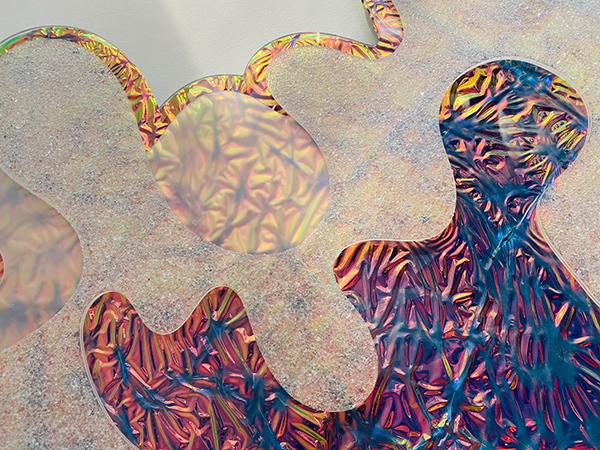
My current work uses a mix of acrylic sheet (similar to plexiglass), vinyl, paint, and crushed glass. The crushed glass is my reclaimed element. I hand-crush discarded picture frame glass, sourced through partnerships with a local charity and a couple of frame shops. In the past, I’ve also used recycled window and bottle glass.
Why plastic, then?
I used to work primarily in glass. These days, I choose materials based on the needs of each project, not the other way around. I consider myself multidisciplinary. One of my ongoing rules is that every piece must have some element of luminosity—something “glass-like.” The acrylic mimics the visual quality of glass and ties back to my history as a glass artist. Many people assume my current cloud-like wall sculptures are made of glass—but they’re actually acrylic plastic.
And that choice is intentional.
Cutting the organic, amoeba-like shapes I use would be extremely expensive in glass and require waterjet technology—something that itself consumes a large volume of water. Acrylic weighs about a quarter as much as glass, which lets me scale up without creating work that’s impossible to handle, ship, or install. It’s safer, cheaper, and dramatically easier to work with in the studio. The lighter weight also reduces packaging and fuel during shipping—a small but notable win in the sustainability conversation. Environmental impact isn’t just about base materials—it’s also about supply chains, manufacturing, and distribution.
You might ask: why not use recycled plastic sheets?
Great question. I’ve looked into them. While there are some recycled acrylic options, there’s currently no Canadian manufacturer that offers the size, finish, or clarity I need. Most suitable products are made in Europe and cost about three times as much as virgin plastic—before you add shipping and import fees. While I’m always happy to pitch the option to clients and collectors, 100% of the time, they choose the more affordable version—and honestly, I can’t blame them.
This leads to the bigger discussion my work often opens up: the real costs of recycling, the challenges of a circular economy, and how much responsibility is unfairly placed on the consumer. Recycled materials cost more because they require more processing—breaking down, reforming, remanufacturing. But are they truly “better” for the environment when we account for energy use and labor in that chain?
Maybe the real conversation isn’t just about recycling—it’s about reducing material use altogether. And when people ask why I use plastic, these are exactly the kinds of conversations that follow.
That’s the goal.
To make the work, and let the work make the discussion.
