

Slow Data: A Conversation with Art-Sci Currents
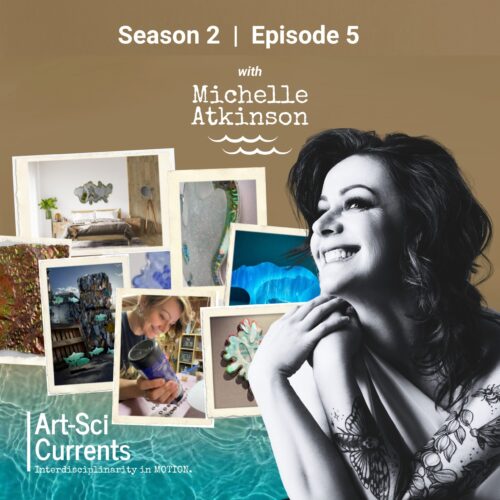
I recently joined host Nicia John for an episode of Art-Sci Currents, a podcast exploring the intersections of art, science and technology. Our conversation gave me an opportunity to step back from individual artworks and talk about some of the larger questions that have been shaping my practice: how we experience data, why beauty and curiosity matter, and what can happen when information is deliberately slowed down.
I often say my work is about weather, but increasingly I think weather is the doorway rather than the destination.
For years, I have used weather and climate data connected to floods, wildfires, storms and other environmental events as source material. I translate numerical information into shapes, then abstract those shapes until the original graph is no longer immediately recognizable. The data remains embedded in the work, but understanding it is no longer the first requirement for experiencing it.
That distinction has become increasingly important to me.
We live with an extraordinary amount of information. Climate communication in particular can arrive as an endless stream of graphs, statistics, headlines and increasingly urgent warnings. More information doesn’t necessarily create more understanding. Sometimes it creates distance or overwhelm.
My work asks what might happen if we approach that information differently.
Rather than trying to communicate an entire environmental event, I isolate fragments. A temperature. A period of rainfall. A particular place and moment in time. I translate that small piece of information through colour, material, light and form, creating something that can be encountered before it is explained.
In the podcast, Nicia described this approach as slow data, and the phrase has stayed with me.
It captures something I have been moving toward intuitively: using art to interrupt the speed at which we consume information. Instead of asking someone to understand everything, perhaps an artwork can simply make them pause long enough to become curious about one thing.
That thinking is also changing the physical work itself.
After years of layering materials, processes and ideas, I have become increasingly interested in simplicity—fewer forms, fewer gestures and more space for materials and processes to behave in ways I haven’t completely predetermined. Coming from a long career in graphic design, where every decision needed a rationale and every project moved toward a deadline, leaving room for uncertainty has been a surprisingly difficult part of developing my studio practice.
It has also become one of the most productive.
Increasingly, I am interested not only in translating scientific information into visual form, but in borrowing from the ways science observes the world: isolating variables, experimenting with processes, documenting change and allowing unexpected results to become information for the next experiment.
That places my practice somewhere between art, science, material research and environmental storytelling—and I’m becoming increasingly comfortable working in that space between disciplines.
The Art-Sci Currents conversation helped me recognize that my role isn’t necessarily to make complex environmental systems easier to understand. Sometimes it is simply to create another way into them.
A beautiful object can create attention. Attention can create curiosity. And curiosity gives us a reason to look closer.
Listen to the conversation
Art-Sci Currents, Season 2, Episode 5
Slow Data: Weather Artist Michelle Atkinson Makes the Case for Simplicity
Listen or watch via Crearte, Spotify, Apple Podcasts or YouTube.
